
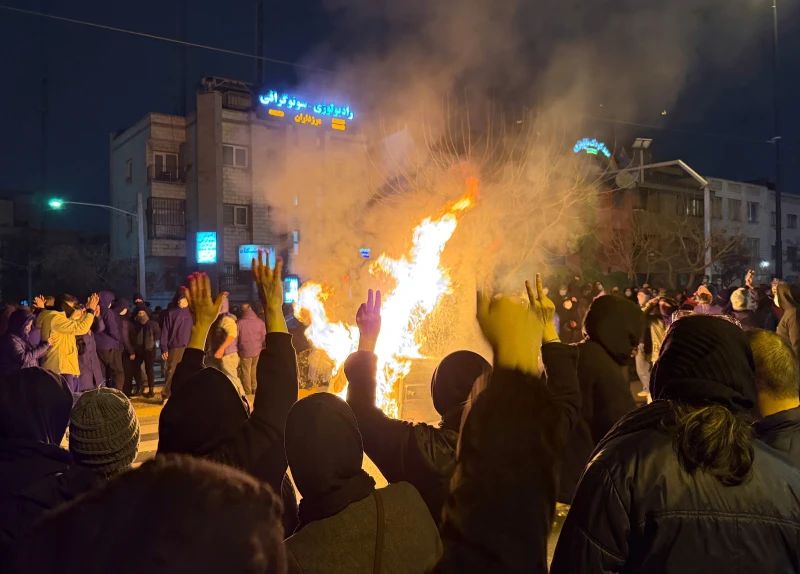
Let me be clear. It will become obvious in the following paragraphs that the Islamic Republic is an awful regime that needs to go. The way they treat their people, particularly their women is horrendous. They enable terrorism through the Islamic Revolutionary Guards Corps, not just against western targets but also in the Middle East itself. They commit atrocities – most likely the bulk of the death toll from the last few days was enabled by the I.R.G.C.
Iranians are extremely brave people. When I first met members of the Iranian diaspora in Christchurch, it was June 2009 and President Mahmoud Ahmadinejad had just been re-(s)elected as President in (s)elections that were anything but clean. They were protesting the outcome, and rallying in support of the many people on the streets in Iran trying to get a recount.
When I visited the protest with another Amnesty member, we were welcome, but asked not to photograph any of the protesters. Many were scared that if their images were on television, family in Iran might be put in jeopardy. It was a gnarly time for them then. A young lady named Neda Agha Soltan had just been shot dead. Ms Soltan was a student who had been targetted by militiamen of the Islamic Republic. She was not doing anything violent at the time of her murder. She became a symbol of the regimes brutality.
Across the years, Iran has arrested and imprisoned various people. Some activists, others – either from Iran or spouses to people from Iran – just visitors whose nationality got them into trouble. None of the cases in mind were fairly handled by the authorities and all of the charges in each instance were trumped up. One of them was a lady named Ghoncheh Ghavami, a young lady who went to a volleyball game in 2016 to cheer on the Iranian team who were playing in an international fixture. She was arrested and detained for attending something that women could not. Amnesty International picked up the case because she had been arbitrarily detained without any of her legal rights acknowledged. Ms Ghavami eventually went on a hunger strike, before the authorities relented.
Two others come to mind. Nasrin Sotoudeh and Nazanin Zaghari-Ratcliffe. Both were the subject of extensive Amnesty International campaigning, including by the N.Z. section, of which I am a member. Ms Sotoudeh, across the course of a decade was arrested and imprisoned several times, and on at least one occasion went on hunger strike. She only ended it because her health had deteriorated too far to safely continue. Her family has been persecuted too – her husband was arrested for his work on womens rights in Iran, and her son was beaten by guards when he tried to visit his father in prison. As far as I know he is still in prison.
Nazanin Zaghari-Ratcliffe is an example of human rights activism done well. A few years ago, with incredible pressure on the regime, Iran released Ms Zaghari-Ratcliffe, who immediately flew home to her family in Britain. It was not before significant controversy though, when the then British Foreign Secretary Boris Johnson interceded, thinking he was doing her a favour by saying that she was training journalists, which was used as evidence against her. Then in 2022, she was used as a bargaining chip by the Iranian Government regarding UKP400 million that was owed. Amnesty International was involved from the start and my local group, as well as the N.Z. section campaigned for her release on several occasions during the time that she was imprisoned.
In 2022 protests flared again. The Islamic Republic had murdered a young lady named Mahsa Amini, whose death ignited activism globally across the Iranian diaspora. I participated in a protest with several others from outside of the Iranian community who welcomed us with open arms at their rally with a huge Iranian flag. Ms Amini became the face of the Woman Life Freedom campaign which was spawned out of renewed determination to improve life for Iranian women.
Now as we try to comprehend by far the bloodiest and most savage attack on Iranian demonstrators by the regime, it has come to my attention that Iran is about start executing people who have been arrested for participating in the protests. And just like the bloodbath a few days ago, Iran is being threatened with strong U.S. action if those executions go ahead.
It is against this backdrop that I demand the Prime Minister of New Zealand Christopher Luxon, or his Minister of Foreign Affairs Winston Peters, to immediately expel the Iranian diplomatic mission from Wellington; declare the Islamic Revolutionary Guards Corps a terrorist organization and sanction the Islamic Republic regime.
No one, except the extremists, will lose if this regime falls over.
 Leftist Kiwi Writes