
“If you don’t bother voting, you can’t have your grumbling rights for the next 3 years”
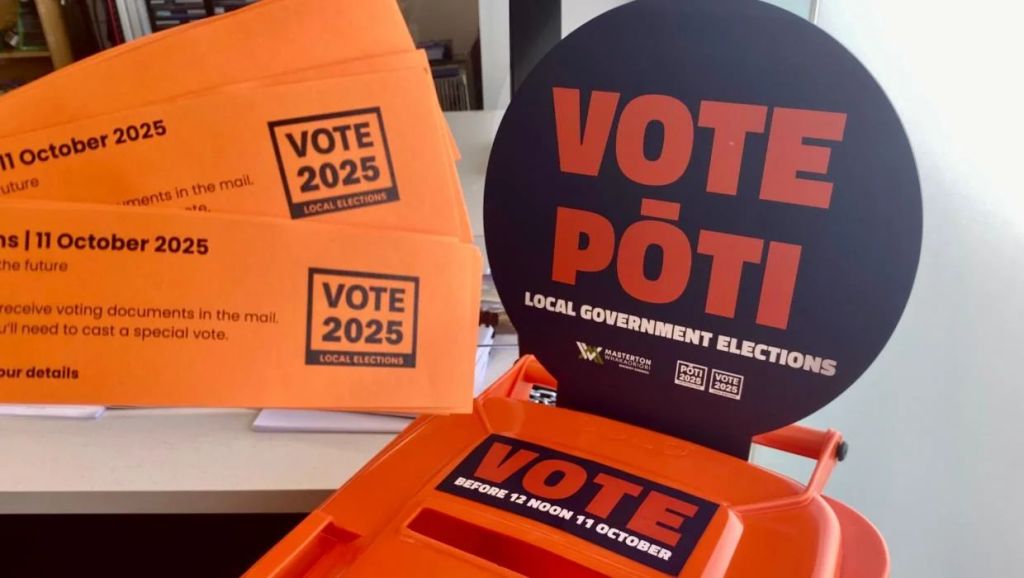
It is Wednesday 15 October, and the dust is settling on the 2025 local government election outcome. In an election cycle that turned out the lowest voter numbers in over 30 years, a mixed bag of results have played out across the country – and look at why we just recorded the lowest turn as a percentage of the population in 36 years.
In Christchurch, where I live, it was very much a case of the incumbents getting another 3 year social contract with voters to continue representing them. Only two new councilors are joining returning Mayor Phil Mauger around the council table. Three wards in Christchurch returned their incumbents by default due to nobody challenging, which I find quite concerning, given that at least one has a bit of checkered reputation as a councillor.
Wayne Brown, Mayor of Auckland was returned by a crushing margin. For a Mayor who got off to a catastrophic start to his first term with his mishandling of the Auckland flood emergency in January 2023 that would have sunk many candidates, Mr Brown’s come back has been somewhat remarkable. Perhaps what I found impressive, given I thought initially that he would be a disaster, is his ability to stand up to central Government on planning matters.
In Dunedin, Wellington and Hamilton, there has been a change of captain at the council table. Changes have also happened in several rural councils where incumbents have suddenly found themselves without a mandate to stay at the council table any longer – Sam Broughton in Selwyn being one.
So, why did we have such a poor turn out? On one hand I think the bullet point answers are comparatively straight forward:
- “I forgot”
- “Who cares? They don’t do anything useful”
- “Why vote for a bunch of idiots?”
- “There was an election!?”
On the other, the reasoning that has led to those bullet points is rather more complex. It raises questions that few seem to have answers to – or be prepared to go looking for. I try to – very briefly go over some of these in the next few paragraphs.
Before I do though, I need to acknowledge the worsening harassment and bullying of candidates that has been enabled in recent years. It has come about in part by the Government’s weakening of hate speech laws, and attacks on “woke culture”/”diversity equity inclusion” policies encouraged by the last Government. This has been fueled by the deliberate importation of culture wars from the United States and Britain – among other places, where people with money and/or political megaphones like British author J.K. Rowling and Florida Governor Ron de Santis – have attacked minorities, including but not limited to transgender people, people of colour and religious minorities. No one should be surprised that a lot of people find this to be really off-putting when putting their hand up for elected positions.
I need to point out that a number of female candidates have had e-mails threatening sexual harassment made against them. One such e-mail actually threatened a candidate with sexual violence against their body. Such e-mails, aside from being extremely alarming for candidates, ultimately threatens democracy by making security a bigger issue than it should ever have to be.
But now I want to look at some of the simpler reasons for such an appalling turn out rate among voters.
I FORGOT
Translated: my ballot papers spent three weeks on the dining room table and it was only when I cleared the table for a family dinner that I even remembered I had them.
Whilst that definitely wasn’t the case in my house, I am sure that this speaks truth to a lot of people around New Zealand. Three weeks to cast ballot papers in a postal vote is a very long time. It is one of the primary reasons why I think we need to reform how we cast votes for the local government elections, and why I can unfortunately see this getting even worse in the near future.
WHO CARES? THEY DO NOTHING USEFUL
Translated: “I haven’t thought about the fact that these people have the power to make decisions about how my rates get used; whether I have to put up with road works for ___ weeks/months whilst the pipes underneath get fixed”
This was very much the case I think for some people on my road, which has been subject to significant road works over the last 9 months whilst the road is rebuilt and a cycleway added. Whilst the north end where I live actually looks quite good now, the very low numbers of people cycling down it make me wonder whether it was worth the effort building the cycleway. Should I be bothered by the fact that the southern part of the road is now having the same done, and that there is still another several months to go?
A BUNCH OF IDIOTS
Translated: I don’t trust any of them – a bunch of trannies, green whack jobs and dole bludgers who have never done a good days work.
These comments and worse have been trotted out by accounts on social media often lacking a profile picture. They form part of the narrative that is taking hold that no good comes of bothering with local council elections. Sometimes when dealing with people like former Wellington City Councillor Ray Chung, whose attacks on fellow councillors and just departed Mayor Tory Whanau, the mistrust is justified – Councillor Chung’s behaviour brought him and his position on the council into disrepute and he rightfully lost his position.
Candidates promise the world and realize quickly after taking office how limited their actual decision making power is; how mundane it is to read local board meeting minutes for 3 years and that the real power in many ways is vested in Wellington. Candidates who get reality checked and acknowledge their limitations are not necessarily the problem so much as scaling down those promises to something that reconciles with the reality of their job.
THERE WAS AN ELECTION?
Last but not least, there are people in society who are so disconnected from what is happening around them, that despite the billboards, the adverts on television, the street corner talks and so forth, at least a few people always manage to not realize that an election just happened. They might come from households and/or backgrounds where current events simply did not register unless it was something like a big earthquake or the education facility they are enrolled at goes on strike or closes. In parts of the country where media are faraway people who never visit remote parts of New Zealand, or the services such as mail and telecommunications are poor like in Tairawhiti, unless one lives in Gisborne or Wairoa it would be easy feel bypassed and wonder what was happening.
 Leftist Kiwi Writes