
I was a member of New Zealand First 2002-2006; 2010-2017, during which time I saw the party grow, implode, revive itself and grow a second time before imploding again in 2020. Now quite the different beast from the one I knew, is New Zealand First really the party that it says it is?
When I first joined New Zealand First in 2002, I was seeking a political party that was moderate in tone, but with distinctly New Zealand oriented policies. In the 17 years between me starting primary school in late 1985 and joining in 2002, I had come to learn about the damage being inflicted on New Zealand by neoliberal market economics. At the same time I wondered why the centre-left Labour Party – despite market economics running counter to their worker based, welfare state oriented ideology – was so determinedly wedded to it.
New Zealand First in the early 2000’s seemed to be a fairly balanced, albeit definitely senior citizen oriented party. I offered to set up a University of Canterbury group in about 2003, noting the Young Nationals/Labour/A.C.T./Greens that were sprouting on campus, but the Board of Directors told me that other parties were better suited to youth. I cautioned against the casual racism that some of the local members were spouting at meetings that I attended – “they (Asians) come here and breed like flies” – but few seemed interested in acting at the time. I let my membership lapse in 2006, after the election funding snafu that blew up that year. About 18 months later in Parliament in 2008, the then Deputy Leader Peter Brown stood up in Parliament and said that there were too many Asians in the country.
So, what did I like about them then, despite all that negativity? Quite a bit. They were advocating for science, for an Emergency Unemployment Benefit for students and did not seem keen on interfering with the Resource Management Act as the other parties were.
Not surprisingly New Zealanders pushed back in 2008 and told the party to reform, by giving it less than the 5% party vote needed to stay in Parliament. It was not a punishment, like what was handed out in 2020 in that the party was easily the biggest outside of Parliament at 4.07% of the party vote. But the message was clear that racism would not be tolerated and that to survive in the 2000’s it needed youth on board.
In 2010, alarmed by the loss of local democracy in Canterbury, I had rejoined the party whilst Labour grappled with the fact that it was not in the Beehive any more. In 2011, N.Z.F. came back to Parliament picking up 8 seats, and just missing a 9th. It achieved this through beginning work on a fledgling youth wing. The party began to modernize its social media, which was largely non-existent and several people of non-N.Z. descent had joined – an Indian ex-Army officer named Mahesh Bindra, a Samoan Corrections Officer named Asenati Lole-Taylor among others.
For the next two Parliamentary terms, N.Z. First slowly but steadily grew. The youth wing became established at several tertiary campuses around the country. The first Facebook and Twitter pages and groups were set up so people using those sites could get to meet the party. A manifesto of party policies included an oceans policy that I wrote; a pro-rata entitlement to superrannuation for people who had only worked in N.Z. for part of their working life; G.S.T. off food (2014 election promise).
In late 2016 though, the winds of change were starting to blow through Parliament. National was still out performing Labour comfortably, but no longer had quite the same lead in the polls that Prime Minister John Key had enjoyed.
Unfortunately winds of change of another sort were starting to blow through New Zealand First. At the 2016 Annual Convention, entire segments of the agenda had been skipped causing widespread consternation on the floor. The Board of Directors were becoming impossible to reach, which was concerning because post-Kaikoura earthquake, Canterbury electorate committees were needing assistance getting back on their feet. Stonewalling of criticism of the Board performance had already seen a few simply give up. More would follow in the coming months.
But another problem was mounting. Shane Geoffrey Jones, a former Labour M.P. who had left that party after accusations of corruption, had joined New Zealand First and was primed to stand at the 2017 election. For some long term party loyalists who long predated my initial membership, this was a bridge too far. Mr Jones had no prior track record of helping the party in any way – he had not been on an electorate, helped fundraise or served on the Board of Directors, and here he was readying to stand for the party ahead of people who had much stronger cases to advance.
To make matters worse, Mr Jones was known on one hand for having a bit of the “gift of the gab”, but in other respects coming across with the diplomatic tact of a bulldozer or sledgehammer. In a time when New Zealanders were starting to want a dose of empathy for their situation, concerns about the environment mounting and no relief in sight for the cost of living, the rise of Jacinda Ardern starkly contrasted with the decrease of N.Z.F. from 12 seats to 9.
I left New Zealand First in this period – possibly for good – but supported the party to the 2017 election. Whilst the 2017 decision to support Labour took many, including myself by surprise, I understand National Party leader Bill English was his first choice. This rebounded on New Zealand First at the 2020 election, when particularly the farmers, the gun lobbyists and those tired of supposed “woke pandering” to minorities either gave their votes to National and A.C.T. or stayed at home.
Those winds of change grew stronger and less pleasant. Somewhere during former Prime Minister Jacinda Ardern’s second term in office, New Zealand First swung hard right. And it has remained hard right ever since. In 2002 it would have been as horrified as Labour and the Greens about what is currently happening in Palestine. It would have called for protection against the craziness of U.S. President Donald Trump and his tariff wars. Far from being a virtually mute voice on the world stage, Winston Peters even between 2011-2020 would have been a far more effective voice for the country than the current edition of the party masquerading under the New Zealand First banner.
Since the 2023 election a burning electrical appliance fire has become a “well involved” house on fire. Shorn of the Tracey Martins, the Denis O’Rourke’s, Darroch Balls and other moderating voices, it has acquired a misfit crew of conspiracy theorists, Trumpists and more. Its “War on Woke” is a massive distraction from the socio-economic problems that rent the country. Its decision to become a hard right party has alienated many moderate voices, as well as the entire left wing of the party. Its contempt for the environment as bulldozed home by Mr Jones has undermined any respect it ever accrued with those concerned about Papatuanuku/Mother Earth. At a time when New Zealand needs a party that can keep a check on the excesses of National and A.C.T., New Zealand First is not so much asleep at the wheel as actively assisting them.
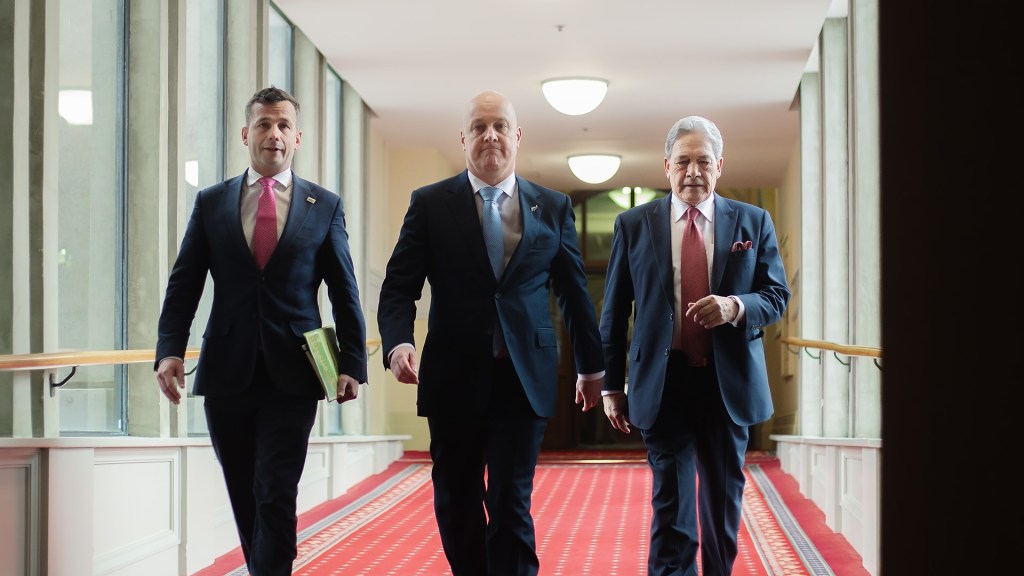
Is New Zealand First really in favour of New Zealand first anymore?
 Leftist Kiwi Writes