
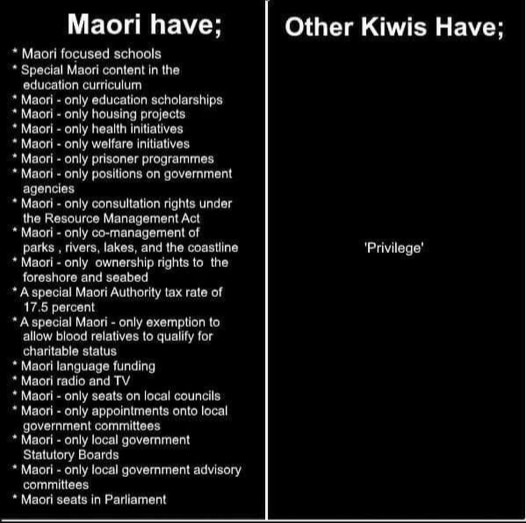
An example of the propaganda against Maori (source: widespread on X)
On 14 November 2024 as the Treaty Principles Bill went to vote in the N.Z. Parliament, young Maori M.P. Hana Rawhiti Maipi Clarke was asked how many party votes her Party had. In response she led a haka challenge against the Bills A.C.T. Party sponsors that has been viewed hundreds of millions of times on social media.
The image above outlines a list of examples where affirmative action has been taken to ensure Maori have equal voice at the table. This is a common point of dispute with anti-affirmative activists believing that this is some kind of apartheid. They are the ones who generally ignore the historical fact that the westernized system of governance has historically treated Maori extremely badly, and in an institutionalized sense virtually made Maori culture, language and world view taboo. Numerous papers published in respected journals have shown how this institutionalized racism has impacted Maori in education, health, welfare and a plethora of other matters, such as this one by Cormack, Harris and Stanley (2019).
To understand who/what is driving this, we need to know about the activists. Before I do, I need to note who those activists are and their role in this:
- A.C.T. Party/A.C.T. Leader David Seymour are sponsoring the Bill of Parliament
- Hobsons Pledge, an astroturf organisation known to have anti-Treaty sentiments and supported by former National leader and former A.C.T. Party M.P. Don Brash
- Christian evangelist Julian Batchelor, whose activities have included a “Stop Co-Governance” tour that was accused – and to some extent found to be – of excluding Maori from meetings
The above list is not exhaustive. Other groups such as Free Speech Union, various Members of Parliament, both past and present have also been involved. For brevity I am focussing on three well known groups/individuals.
The primary activists are the A.C.T. Party, who promised that they would introduce legislation that would subject The Treaty of Waitangi Act, 1975 to a referendum. The legislation, as former Treaty Negotiations Minister Christopher Finlayson notes, was always going to draw such a response in Parliament. Over the decades, one of the great bipartisan efforts of Parliament has been to get treaty negotiations with Iwi and hapu done, which Mr Finlayson now believes is being undone.
Other activist actors include Hobsons Pledge, who are opposed to affirmative action for Maori people. H.P. have significant membership and funding to draw upon. Former Members of Parliament such as N.Z.F. Casey Costello have been involved with it. Among their activities have been widespread leaflet drops in letter boxes around the country, full page adverts in major New Zealand newspapers, some of which the Advertising Standards Authority said were at least in part misleading.
Other individual activist actors include Julian Batchelor, who ran a protest campaign against the controversial Co-Governance policies of the previous Labour-led Government. Mr Batchelor is known for his extreme rhetoric, referring the Maori greeting “kia ora” to the Nazi-era “sieg heil”; his exclusivist public meetings where Maori were only welcome if they sat down and shut up in a forum that was exclusively anti-Maori. He led protests in several centres in September 2023 trying to drum up anti-Maori rhetoric, which were often met by counter protests several times their size. Although no violence occurred, there were several stand offs.
The National and New Zealand First parties have both since said that they will not be supporting the Treaty Principles Bill beyond the first Parliamentary reading. However it needs to be said that both have strong anti-Maori sentiments in their membership. Prime Minister Christopher Luxon did offer a note of hope with a comment:
“You do not go negate, with a single stroke of a pen, 184 years of debate and discussion, with a bill that I think is very simplistic.”
Will this be a first step to pushing back against those Cabinet and caucus members who believe that too much time and effort is being spent healing Treaty grievances? I do not know, but in good faith I am assuming his party’s 49 votes and New Zealand First’s 8 votes will be joining Labours 34, the Greens 15 and Te Pati Maori’s 6 votes against.
For now though, and into early January, the Treaty Principles Bill is at the public submissions phase, where New Zealanders will be able to make submissions for/against it. Then it will go the Second Reading in Parliament, where we will see whether Mr Luxon’s promise not to support it, holds true.
 Leftist Kiwi Writes
One thought on “The wrongness of the Treaty Principles Bill: Part II”